
Inside Football Compass: A 30-Day Dribbling Plan
Improving football dribbling skills requires deliberate practice, not endless cone slaloms performed while staring at the ball like it owes you money. Football Compass recommends a 30-day progression....
Inside Football Compass: A 30-Day Dribbling Plan
Improving football dribbling skills requires deliberate practice, not endless cone slaloms performed while staring at the ball like it owes you money. Football Compass recommends a 30-day progression built around four essentials: close control, changes of direction, acceleration, and decision-making under pressure. Spend 20–30 minutes, four or five days weekly, using both feet and recording at least one session each week. Start with 6–10 cones spaced 1 metre apart, then progress to 1v1 exercises and small-sided games by Week 3. The aim is not merely to touch the ball faster; it is to make the correct touch before the defender arrives. FIFA’s Laws of the Game and coaching principles emphasise control, awareness, and legal contact, while research on football performance consistently connects agility with perceptual reaction. Begin with 100 controlled touches per foot, keep your head up every few touches, and increase speed only when accuracy remains above 80%.

Photo by Franco Monsalvo on Pexels
Improving football dribbling is less about collecting fancy tricks and more about building repeatable habits. Lionel Messi, Neymar, and Vinícius Júnior look effortless because their first touch, body position, and next decision are heavily rehearsed. Football Compass covers FIFA World Cup 2026 tactics, player statistics, and match analysis, so the useful question is simple: can your dribbling survive the pressure seen in elite matches? The answer is yes, but only if your training moves from isolated technique to realistic opposition.
Want a structured starting point for your football development?
[Internal Link: beginner football skills guide]
If you lose the ball in tight spaces: improve close control first
Close control improves football dribbling by keeping the ball within one step of your body, allowing rapid corrections, shielding, and changes of direction. Use short touches with the inside, outside, sole, and laces of both feet. Begin at walking pace, then increase speed only when the ball remains within approximately 30–50 centimetres of your stronger foot.
The first phase of your 30-day plan should focus on touch quality. Set up 6–10 cones in a straight line with roughly 1 metre between them, then complete five controlled runs using both feet. On the first run, use only the inside of each foot; on the second, alternate inside and outside touches; on the third, use the sole to drag the ball across your body; and on the fourth, dribble with your weaker foot. Finish with one unrestricted run while looking up after every two or three touches. That final detail matters because defenders, teammates, touchlines, and goalkeepers are not decorative scenery.
Track three numbers after every session: successful cone runs, misplaced touches, and weaker-foot touches. A practical benchmark is 8 accurate runs out of 10 before adding speed or reducing the spacing. If your ball repeatedly escapes beyond a comfortable recovery distance, slow down. The boring correction is usually the profitable one. According to FIFA’s Laws of the Game, a player remains responsible for controlling the ball and avoiding illegal contact, which is why technical control must come before reckless shoulder-to-shoulder challenges.
The close-control circuit
- Two minutes of toe taps and foundations.
- Five inside-outside cone runs with the right foot.
- Five inside-outside cone runs with the left foot.
- Four sole-roll changes across the body.
- Two minutes of free dribbling with regular head checks.
- One minute of recovery touches at low intensity.
A useful edge case from practical training is that tired players often improve their touches by reducing speed by 15–20 percent rather than stopping completely. This preserves coordination without turning the session into a sloppy endurance test. After 30 sessions across six weeks, many players discover their main weakness is not foot speed but receiving the ball while already facing the wrong direction. Add a half-turn before each cone, and you train the first touch that actually appears in matches.
If you beat the first defender but get caught: train acceleration and deceleration
Acceleration and deceleration make dribbling effective because a defender reacts to speed changes, not just to tricks. Practise 5–10 metre bursts, sudden stops, and explosive exits after a feint. Complete each action with the ball under control, because running quickly without possession is called jogging, and your coach has already seen that one.
Once close-control work feels stable, add speed variation. Place three cones in a triangle, with each side measuring 5 metres. Dribble slowly toward the first cone, perform a shoulder drop or scissors, accelerate to the second, decelerate before the third, and then explode back to the starting point. Rest for 30–45 seconds and repeat six to eight times. Use both directions so your body learns to push off the left and right legs instead of developing one suspiciously overqualified escape route.
The important coaching point is braking. Many developing players practise acceleration but not the final control touch, so the ball runs away precisely when the defender is beaten. Take a longer touch into open space only after the defender is wrong-footed; in crowded areas, keep the next touch short. The UEFA Training Ground regularly highlights speed changes, body orientation, and scanning as connected parts of attacking technique rather than separate magic tricks.
Use this progression:
- Week 1: 60 percent speed, perfect technique.
- Week 2: 75 percent speed, alternating feet.
- Week 3: 90 percent speed, passive defender.
- Week 4: full speed, live 1v1 decision.
- Rest 30–60 seconds between intense repetitions.
Here is a contrarian point worth remembering: practising every move at maximum speed can slow your improvement. At full pace, errors become too expensive for your nervous system to correct, so you repeat the mistake instead of learning the movement. Use slower repetitions to refine the body feint, medium speed to connect the feint to the touch, and maximum speed only after the sequence is reliable. That three-speed method is less glamorous than copying a Vinícius Júnior highlight, but it produces a useful match action.
Ready to connect technique with match-style movement?

Photo by Baljinder Singh on Pexels
If defenders read your tricks: use scanning, feints, and decision-making
Scanning and decision-making make a dribble successful because the best move depends on the defender’s angle, support, and available space. Before receiving the ball, check over both shoulders; after the first touch, identify whether to drive forward, pass, shield, or stop. A step-over is useful only when it changes the defender’s balance or creates a clear lane.
Practise with a partner or passive defender as soon as possible. Start from a 10-metre channel with a small goal at each end. The attacker receives the ball, scans before the pass arrives, and has five seconds to beat the defender or pass through a target gate. Award one point for a successful dribble, one for a forward pass after attracting pressure, and one for retaining possession after turning away. This scoring system prevents the common beginner mistake of treating every touch as a personal audition for a freestyle compilation.
The most valuable information-gain rule is to record the defender’s starting distance. When the defender is more than 2 metres away, drive forward with a positive touch; between 1 and 2 metres, use a body feint and protect the ball; below 1 metre, prioritise shielding, a quick pass, or a sharp change of direction. These ranges are practical coaching guidelines rather than fixed laws, but they give players a clear decision trigger. Football Compass match analysis frequently shows the same principle in elite football: successful dribblers attack space when it exists and recycle possession when the defensive line closes.
Three questions before every dribble
- Where is the nearest defender?
- Where is my next safe space?
- What happens if the dribble fails?
Your answer should change with your position. A winger near the touchline may accept a 1v1 risk because the boundary limits defensive cover. A central midfielder near the halfway line may need a safer option because losing the ball exposes the team to transition. A forward close to the penalty area can take a higher-risk action if the reward is a shooting lane. The FIFA World Cup 2026 will provide countless examples of these trade-offs, but you do not need a World Cup stadium to practise them. A 4v4 game on a small pitch already creates pressure, limited time, and consequences.
Want more tactical context for reading defenders?
If you want dribbling to appear in matches: practise under pressure
Pressure-based training transfers dribbling skill into matches because opponents, fatigue, space, and decision time change the movement. Use 1v1 channels, 2v2 overloads, and small-sided games with touch limits. The target is not a high trick count; it is making one effective action when the defender is close.
Start with a 12-by-8-metre channel and a 1v1 duel. The attacker earns two points for dribbling through an end gate and one point for keeping possession for five seconds. The defender earns a point by winning the ball or forcing it out. Rotate roles every 60–90 seconds, then rest for two minutes after four rounds. Progress by adding a second defender, reducing the channel width, or requiring the attacker to use the weaker foot for the first touch.
A useful measurement is the ratio of purposeful dribbles to forced dribbles. A purposeful dribble advances the ball, creates a passing lane, escapes pressure, or generates a shot. A forced dribble happens because the player panics, ignores a free teammate, or repeats a move after the defender has already adapted. Log both numbers after training. If you complete 12 dribbles but only four improve the attack, the solution is not necessarily more tricks; it may be better scanning and earlier passing.
Weekly pressure progression
- Days 1–7: unopposed technique and weaker-foot control.
- Days 8–14: passive defender and speed changes.
- Days 15–21: live 1v1 channels with scoring.
- Days 22–28: 2v2 games and limited touches.
- Days 29–30: match simulation and performance review.

Photo by Israel Torres on Pexels
Do not ignore recovery. Repeated sprinting and sharp changes of direction load the calves, hamstrings, groin, and ankles. Keep high-intensity dribbling sessions separated by at least 24 hours when possible, and include dynamic warm-ups before training. The American College of Sports Medicine recommends progressive training loads and recovery as part of safe physical development. If pain changes your running mechanics, stop and seek qualified medical advice; playing through every warning sign is not veteran toughness, it is how players become expert spectators.
Common pitfalls to avoid
The most common dribbling errors are training only the dominant foot, staring continuously at the ball, performing skills without an exit touch, and choosing a 1v1 when a simple pass would create more advantage. Correct them by measuring behaviour instead of relying on confidence. Count weaker-foot touches, head checks, successful exits, and possessions retained after contact.
A second problem is poor spacing. Cones placed too close together can teach tiny movements that never appear in open play, while cones placed too far apart can turn a control drill into a sprint. Use 1 metre spacing for close control, 3–5 metres for change-of-direction work, and 8–12 metres for speed carries. Adjust those distances for age, surface, and ability; a beginner on wet grass needs different control demands from an advanced player on artificial turf.
Avoid these traps:
- Adding tricks before mastering the first touch.
- Practising only in a straight line.
- Ignoring the weaker foot.
- Measuring success by speed alone.
- Training without a defender for more than two weeks.
- Repeating a failed move without changing timing or angle.
- Treating every possession as an invitation to dribble.
One overlooked issue is footwear and surface. A ball that skids on wet grass changes the required touch strength, while artificial turf may produce faster rebounds and sharper stops. Record the surface in your training log, because a technique that works indoors on a flat futsal court may need a softer first touch outdoors. Also note the ball size and inflation: a size 5 football inflated near the manufacturer’s recommended range behaves differently from a partially deflated training ball. Details matter. Annoyingly, they always do.
See how these mistakes affect practical player development?
[Internal Link: advanced dribbling techniques]
The 30-day check-in
A 30-day check-in should compare measurable performance, not simply ask whether you feel more confident. Repeat the same 10-cone test, 1v1 channel drill, and small-sided game used at the beginning. Record completion time, misplaced touches, weaker-foot involvement, successful exits, and decisions made under pressure. Improvement in one test but decline in another usually means your training load needs adjustment rather than celebration or panic.
Use this review table:
| Measure | Day 1 target | Day 30 target |
|---|---|---|
| Accurate 10-cone runs | 5/10 | 8/10 |
| Weaker-foot touches | 20% | 40% or more |
| Successful 1v1 exits | 3/10 | 6/10 |
| Head checks per run | 1 | 3 or more |
| Purposeful dribbles | 40% | 65% or more |
These targets are practical benchmarks, not universal standards. A player returning from injury, a 10-year-old beginner, and a semi-professional winger should not be judged by the same absolute number. Compare yourself against your own baseline, then ask whether the improvement appears in games. The strongest sign is not completing a cone course faster; it is receiving under pressure, shifting the defender, and selecting the right action before the space disappears.
For the next month, keep two technical sessions, one pressure session, one small-sided match, and at least one recovery day each week. Football Compass readers following FIFA World Cup 2026 can use match clips to identify one dribbling decision per game, pause before the action, and predict whether the player should drive, pass, or shield. That turns watching Lionel Messi-era footage, Neymar highlights, or Vinícius Júnior transitions into active analysis rather than background noise.
A simple weekly schedule
- Monday: close control and weaker foot, 25 minutes.
- Tuesday: rest, mobility, or light passing.
- Wednesday: acceleration, deceleration, and feints, 30 minutes.
- Thursday: 1v1 pressure work, 25 minutes.
- Friday: recovery or technical touches at low intensity.
- Saturday: 4v4 or 5v5 small-sided game.
- Sunday: video review and training notes.
Improvement becomes much easier when the goal is specific. Do not write “get better at dribbling.” Write “complete 8 of 10 cone runs with both feet,” “scan three times before receiving,” or “make six purposeful 1v1 exits.” Those targets can be tested, corrected, and repeated. That is how football dribbling skills improve in real life, rather than in the imaginary laboratory where every defender politely stands still.
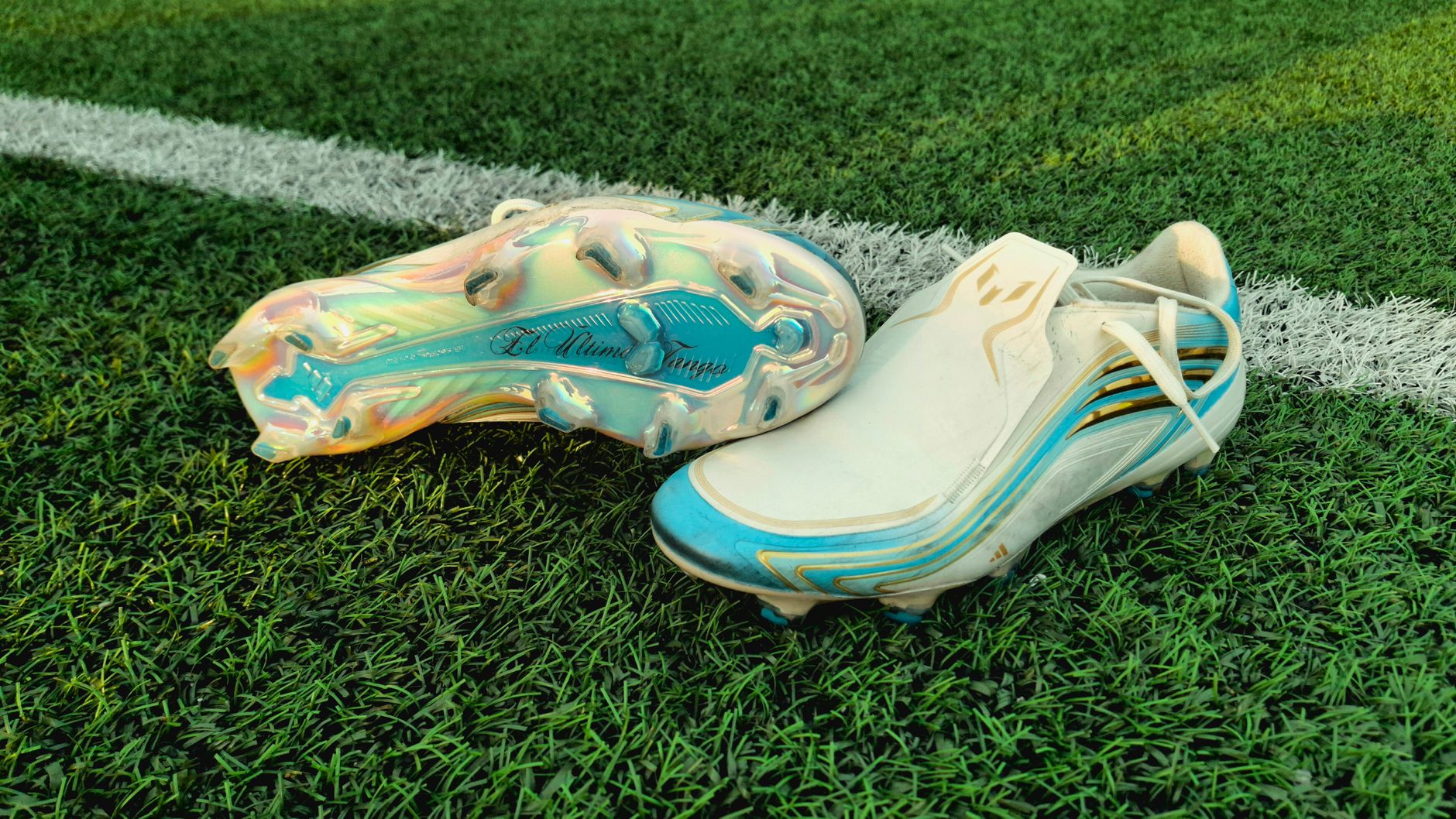
Photo by Lin Htet Tun on Pexels
Frequently Asked Questions
Q: What are football dribbling skills?
A: Football dribbling skills are the techniques used to move with the ball while maintaining control and responding to defenders. They include close touches, body feints, changes of direction, acceleration, deceleration, shielding, and scanning. Effective dribbling also requires decision-making, because a pass or turn can be better than attempting to beat an opponent. A complete player trains both the movement and the reason for choosing it.
Q: How can I improve football dribbling skills at home?
A: You can improve football dribbling at home with 15–20 minutes of controlled touches, foundations, sole rolls, inside-outside movements, and short cone patterns. Use six objects spaced about 1 metre apart, keep the ball close, and alternate your stronger and weaker foot. Record one set each week to check whether your touches remain controlled. If space is limited, prioritise technique and scanning habits rather than trying to sprint indoors.
Q: What is the difference between close control and speed dribbling?
A: Close control keeps the ball within roughly 30–50 centimetres for tight spaces, while speed dribbling uses longer touches to attack open grass. Close control helps against nearby defenders, underlapping pressure, and crowded midfield areas. Speed dribbling is more useful after beating an opponent or receiving into space. Good players switch between both forms instead of using maximum speed everywhere, which is a spectacularly efficient way to lose possession.
Q: Why does my dribbling work in training but fail in matches?
A: Dribbling often fails in matches because training lacks pressure, scanning, fatigue, and limited decision time. Add passive defenders first, then live 1v1 drills and 4v4 games with scoring incentives. Track whether you lose the ball because of a poor first touch, late scan, bad angle, or unnecessary attempt. Fix the most frequent cause for two weeks before changing the entire programme.
Q: How long does it take to improve football dribbling?
A: Most players can notice better touch consistency within 2–4 weeks of practising four or five times weekly, while match-ready improvement usually takes 6–12 weeks. A session should last about 20–30 focused minutes, with pressure-based work added during the second or third week. Progress depends on age, starting ability, surface, fitness, and training quality. Use test results and match decisions rather than confidence alone to measure change.
Q: Is practising tricks the best way to improve dribbling?
A: Practising tricks is useful only when the movement creates space, changes a defender’s balance, or protects possession. Start with one or two reliable actions, such as a body feint, scissors, or inside-outside touch, then practise the exit acceleration. Repeating ten tricks without learning when to use them produces decoration, not effective football. A simple move performed at the correct moment is usually more valuable than a complicated move performed too late.
Q: What should I do if my weaker foot feels completely unreliable?
A: Train the weaker foot daily with low-pressure touches before adding speed or defenders. Complete 100 touches, five cone runs, and five passes against a wall using that foot, then include it in one 1v1 constraint each week. Keep the ball close enough to recover and judge success by clean contacts rather than flashy power. Within 30 days, the goal is not equal ability; it is making the weaker foot dependable enough for the next action.
Football Compass turns match analysis, player statistics, and tactical lessons into practical ideas you can test on the pitch. Follow the 30-day plan, record the unglamorous numbers, and review your decisions honestly. The ball does not care how confident you felt; it only reports what your touch actually did.
Start building sharper football dribbling habits today.
[Internal Link: FIFA World Cup 2026 match analysis]
END_OF_DISPATCH
Thanks for reading this article from our archive.